
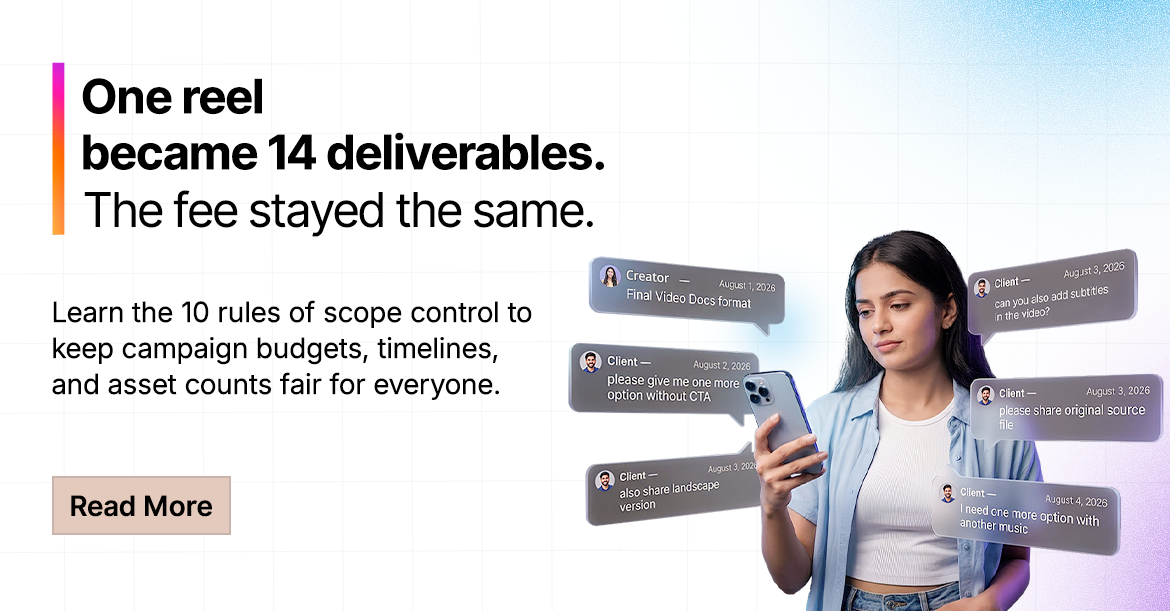
The agreement was for one Reel. By launch day, the creator had delivered a 30-second master, cutdowns, reframed versions, language edits, alternate CTAs, a clean export, a thumbnail and raw footage.
Fourteen deliverables, one fee. No one formally changed the brief, the extra work simply arrived one request at a time. A 15-second version, a square crop, an export without music, the raw files.
Each request sounded small on its own, but together they added up to an entirely new production workload. That is how scope creep usually happens, not through one major change, but through a series of minor additions that gradually expand the work.
The problem is not that brands need multiple assets. The problem is treating all of those assets as though they are still just “one Reel.”
1. Count outputs, not ideas
One concept can become several:
- Durations
- Aspect ratios
- Languages
- Hooks
- CTAs
- Captioned or clean versions
- Paid-media exports
The workload multiplies quickly.
Two cutdowns across three languages already means six files.
A useful rule is:
Total assets = concepts × durations × formats × languages × variants, plus supporting files.
If the brief says “one Reel plus versions”, those versions should be named before the fee is agreed.
2. Define the deliverable properly
“One Instagram Reel” is not enough.
The scope should specify:
- Number of final files and live posts
- Runtime
- Aspect ratio and file format
- Captions, graphics, music and CTA requirements
- Language versions
- Cutdowns and alternate versions
- Thumbnail or caption copy
- Raw footage or project files
- Posting requirements
- Delivery date
The creative brief explains what the content should communicate.
The scope sheet explains what work is being purchased.
You need both.
3. Treat cutdowns as additional assets
A planned cutdown can be built into the original shoot.
An unplanned cutdown may require a new edit, rewritten captions, retimed music, revised product visibility and another approval cycle.
Sometimes the existing footage will not support it at all.
Agree in advance:
- How many cutdowns are included
- Their durations
- Required formats
- Where they will be used
- How many feedback rounds apply
A shorter video is still an asset.
4. Separate revisions from new work
A revision fixes or improves the agreed deliverable.
A change request changes what was agreed.
A revision might include:
- Correcting text
- Adjusting pacing
- Replacing an approved shot
- Refining a caption
Additional work might include:
- A new product or offer
- Another hook or CTA
- A new language
- Another aspect ratio
- A changed concept
- New footage
The test is simple:
Are we correcting the agreed work, or asking for different work?
That distinction should appear in the contract.
5. Consolidate feedback
“One round of feedback” should mean one consolidated set of comments.
If brand, agency, legal and media teams send separate notes over several days, the creator has effectively completed several rounds.
Nominate one person to collect comments, resolve contradictions and send the final instruction.
The agreement should also define:
- Number of revision rounds
- Who gives final approval
- Response times
- Cost of extra rounds
- What happens when feedback is late
If approval arrives late, the production deadline should move too.
6. Make reshoot responsibility clear
A reshoot can be expensive.
If the creator ignored an approved requirement or made a production error, they should generally correct it.
If the brand changes the product, claim, offer, packaging or creative direction after approval, the reshoot is additional work.
The principle is straightforward:
The cost of a change should follow responsibility for the change.
Before reshooting, agree the requirement, fee, expenses and new deadline in writing.
7. Treat raw footage separately
Raw footage is not simply another export.
It may contain unused performances, private surroundings, unlicensed material or footage the creator never approved for publication.
Delivering it can also require significant preparation and storage.
Raw-footage terms should answer:
- What files are included?
- How will they be prepared?
- What can the brand do with them?
A fee for supplying raw footage is separate from permission to create new content from it.
Receiving the files does not automatically grant unlimited usage rights.
8. Scope localisation properly
“Three languages” can mean very different things:
- Subtitles
- Voice-over
- Dubbing
- Full re-performance
Each carries a different workload.
A master plus two cutdowns across three languages already creates nine language-specific assets.
Specify:
- Languages required
- Type of localisation
- Who provides and checks translations
- Which versions need translating
- Whether creator approval is required
Subtitles and a new spoken performance should not automatically carry the same price.
9. Price extras before they become urgent
The night before launch is the worst time to negotiate additional work.
Instead, agree a simple add-on rate card for common requests such as:
- Extra cutdowns
- New aspect ratios
- Alternate hooks or CTAs
- Additional revision rounds
- Reshoots
- Translation
- Raw footage
- Rush work
- Additional creator posts
The goal is not to charge for every minor adjustment.
It is to make the cost of meaningful additional work predictable.
10. Record changes
A change does not require another lengthy contract.
A short written change order can confirm:
- What is changing
- Number of new outputs
- Additional fee
- Production costs
- New deadline
- Usage-right changes
- Who approved it
Email or a project-management platform may be enough.
What matters is that both sides can later see the same scope, price and timeline.
Urgency does not create consent.
Before signing, ask these questions
Can both sides clearly answer:
- How many final files and posts are included?
- Which formats, durations and platforms are required?
- How many versions and languages?
- Are raw files included?
- How many revision rounds?
- What counts as a change request?
- Who consolidates feedback?
- Who pays for a reshoot?
- What do common extras cost?
- Does additional work change the deadline or usage rights?
If the answer is unclear, the campaign does not yet have one agreed scope. It has several assumptions.
Clear scope protects everyone
Good scope control is not about making campaigns inflexible. It gives campaigns a fair way to change.
Creators can price their work properly. Brands know what they are buying. Agencies get cleaner approvals. Production teams spend less time managing surprise versions.
One Reel can legitimately become fourteen deliverables. Just make sure the scope becomes fourteen deliverables too. And the fee follows.